Ateliers d'art de France presents

Meeting Daniela Bergschneider, creator of the signature piece of Révélations 2027

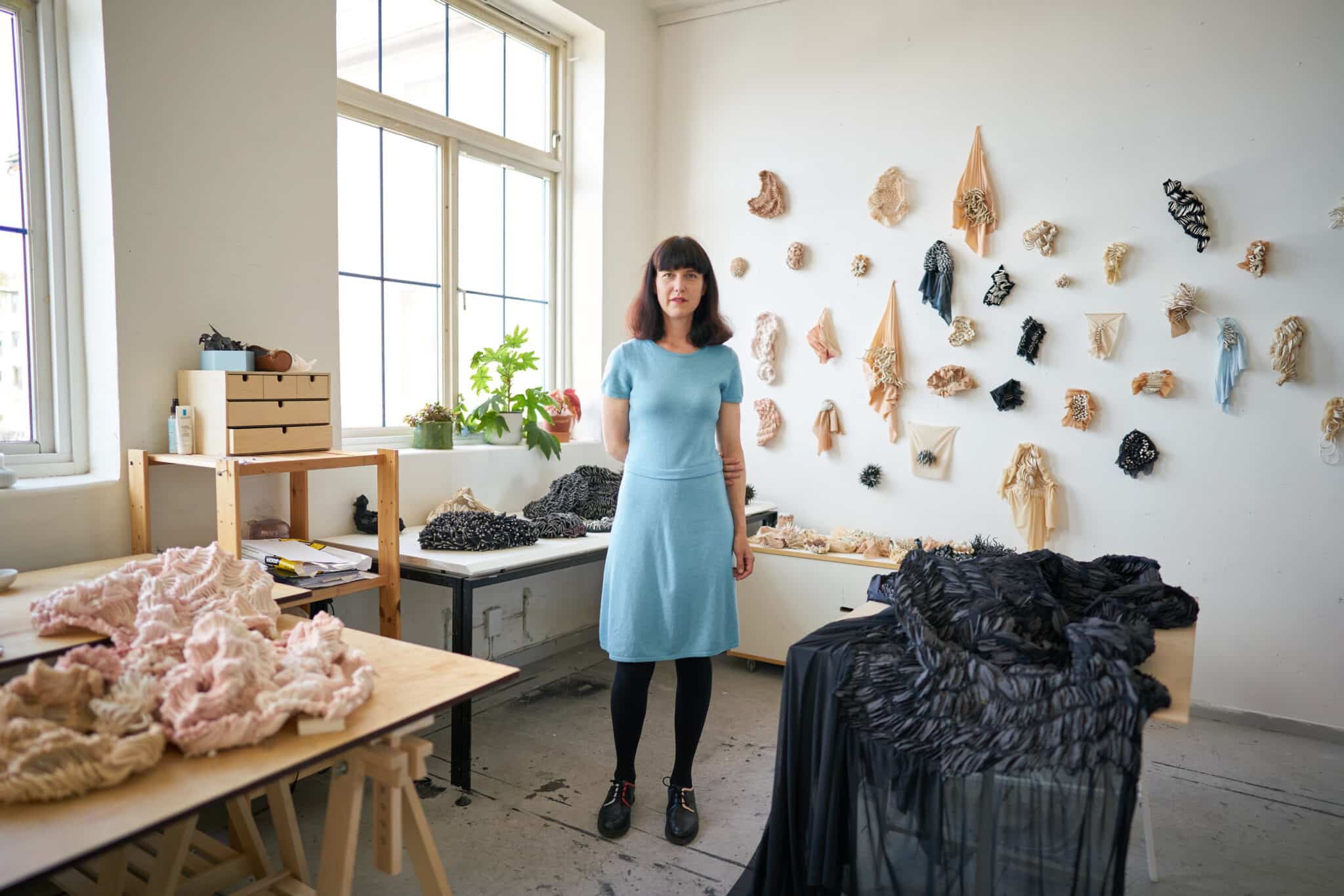
Her work has been selected as the signature piece of the 8th edition of Révélations. In her workshop in a former sardine factory on a pier of Bergen, Norway, Daniela Bergschneider, a creator originally from Germany, sets materials in dialogue: porcelain and nylon come together to create body sculptures and installations. A meeting with a creator whose works exist between the familiar and the unknown, between what could have been and what might still become, between human craftsmanship and nature's invention.
Can you tell us about your background?

I grew up in a family where working with your hands and making played an important role, and it felt very natural for me to engage with textile as a material. At the same time, I was fascinated by the human body — its fragility, its strength, its internal structures. 

After training as a teacher in Germany and studying textile design in Hamburg, I was always searching for a material that could function as a kind of "bone" within my sculptures, something that could contrast the softness of textile and provide structural support. A residency at the Nordik Artists Centre Dale in Norway became a turning point for me: I discovered how closely art and craft are connected there, and applied for my Masters in Art at the Art Academy in Bergen. That is where ceramics became the backbone of my work.

 Bringing textile and porcelain together allowed my sculptures to grow into something more bodily, forms that feel both fragile and strong, between skin and skeleton and interior and exterior.

How would you describe your artistic approach?

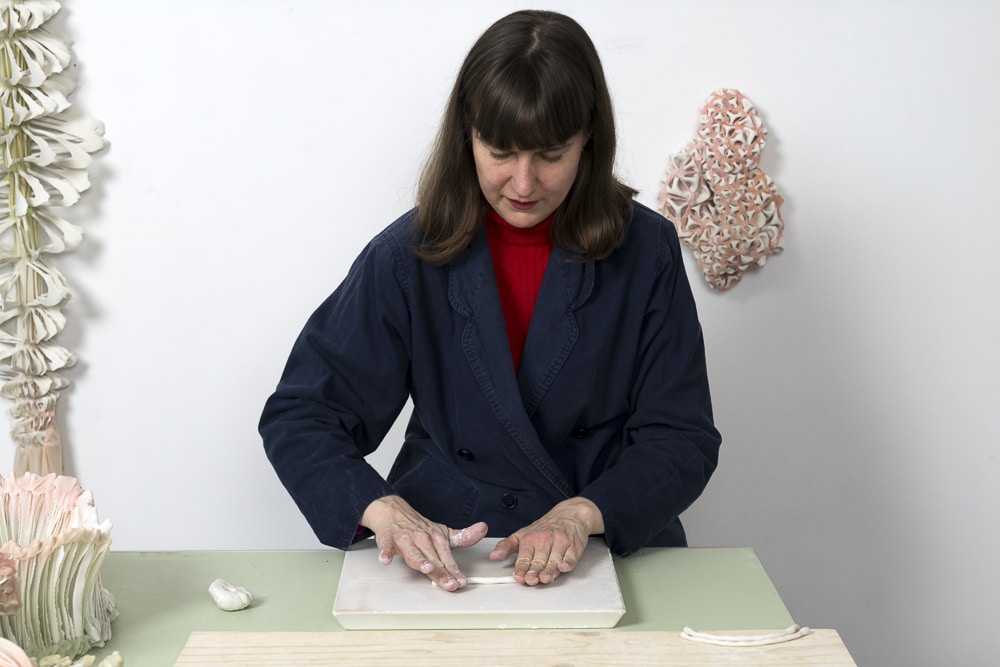
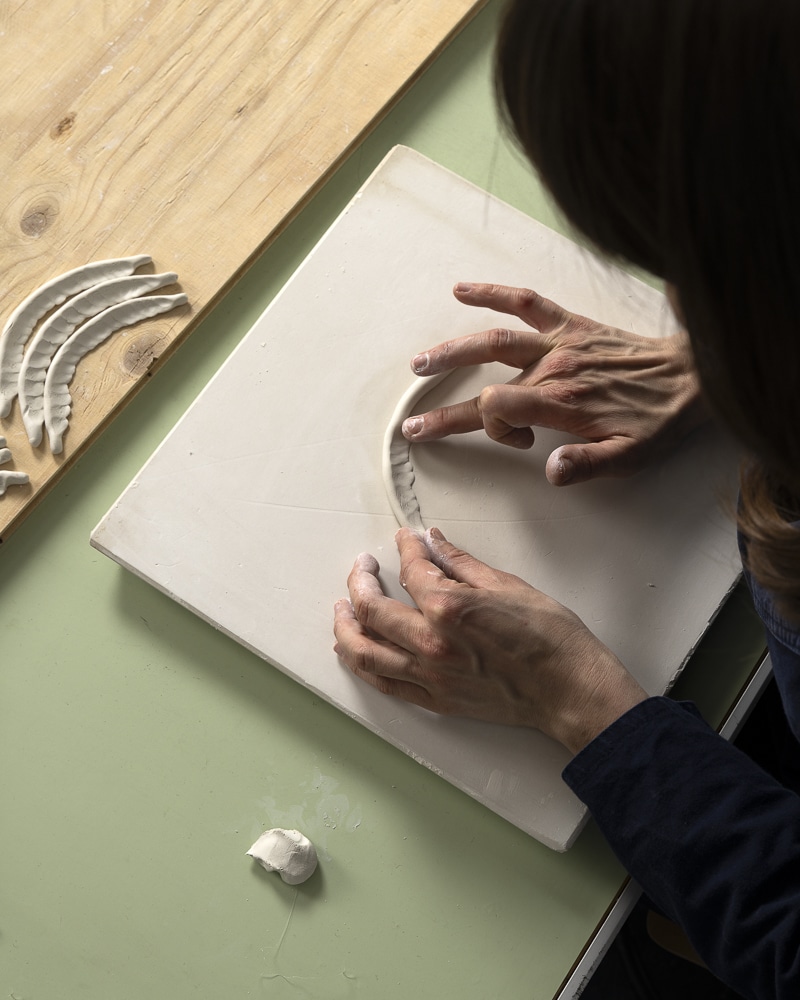
My approach is process-based and intuitive. I don't start with a fixed image that I have created in my head. Instead I develop ideas through making. I often say that I "think through making." Textile and ceramics — two highly sensual materials with a long tradition in human kind — are at the heart of my practice. Repetition and accumulation structure my practice: I create hundreds of small, unique ceramic elements and assemble them into larger structures. This process is slow and meditative, and the slight irregularities between each element contribute to an organic, almost living quality. My work is driven by a desire to express something that cannot be articulated in words. I am searching for a visual language that speaks directly to the senses — what I think of as "visual tactility": I want viewers to feel a physical response and engage with the work on a bodily level before understanding it intellectually.
How do you stand out with your technique?

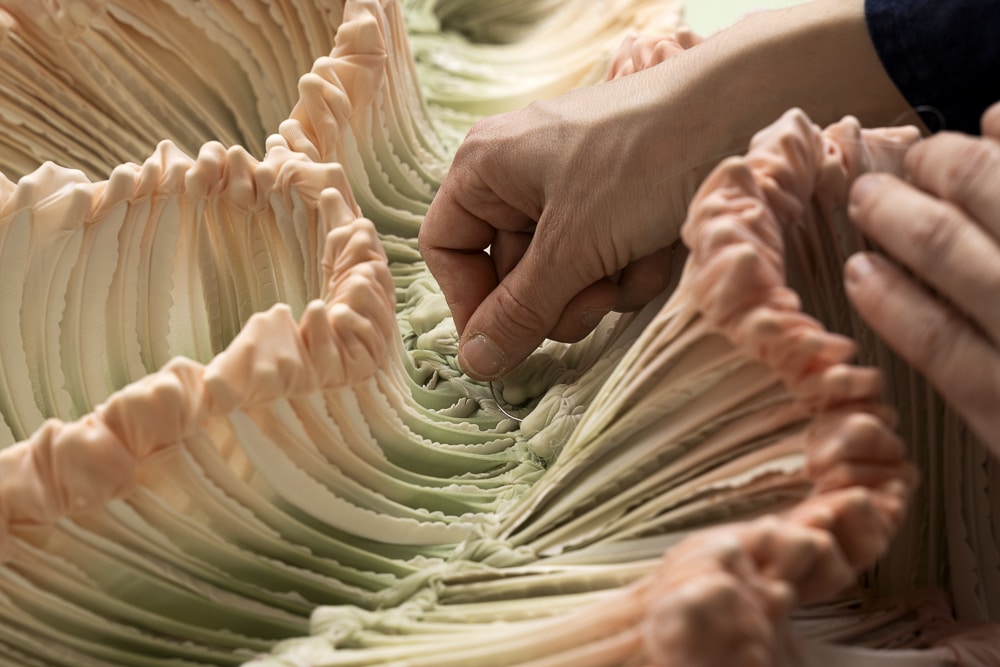
My works are material hybrids made from hard and soft elements, where the porcelain functions as a skeletal framework, while the textile acts as a membrane or skin that stretches over and binds the forms together. What defines my work is the interdependence of the two materials, which need each other to create a functioning whole. The textile is very thin and elastic, yet strong enough to hold thousands of elements and creates a protective layer around the hard, but fragile porcelain elements. Together they form something that is both resilient and vulnerable.

“The process of searching fascinates me, the search for something that I do not yet fully know and that I develop in dialogue with the materials. I work towards a moment of surprise, where the materials and surfaces take on a life of their own that is out of my control.”

How do you find inspiration?

I am inspired by natural processes — growth, decay, gravity — and from scientific imagery. Ernst Haeckel fascinates me: his detailed images of microscopic organisms reveal structures that feel both alien and familiar, almost architectural, which resurface unconsciously in my practice. But a lot of my inspiration comes directly from working with the materials themselves. The process itself becomes a way of thinking and discovering. I am also influenced by everyday observations and encounters with other artists' works.

Could you tell us more about Gewächs VI, the work selected for Révélations? And about the meaning of its name?

Gewächs VI belongs to a series of works that explore growth processes. In German, "Gewächs" implies something that has sprouted or developed on its own. It reflects the idea that the sculpture is not a fixed object, but something that seems to be in a state of becoming, of growing and unfolding.

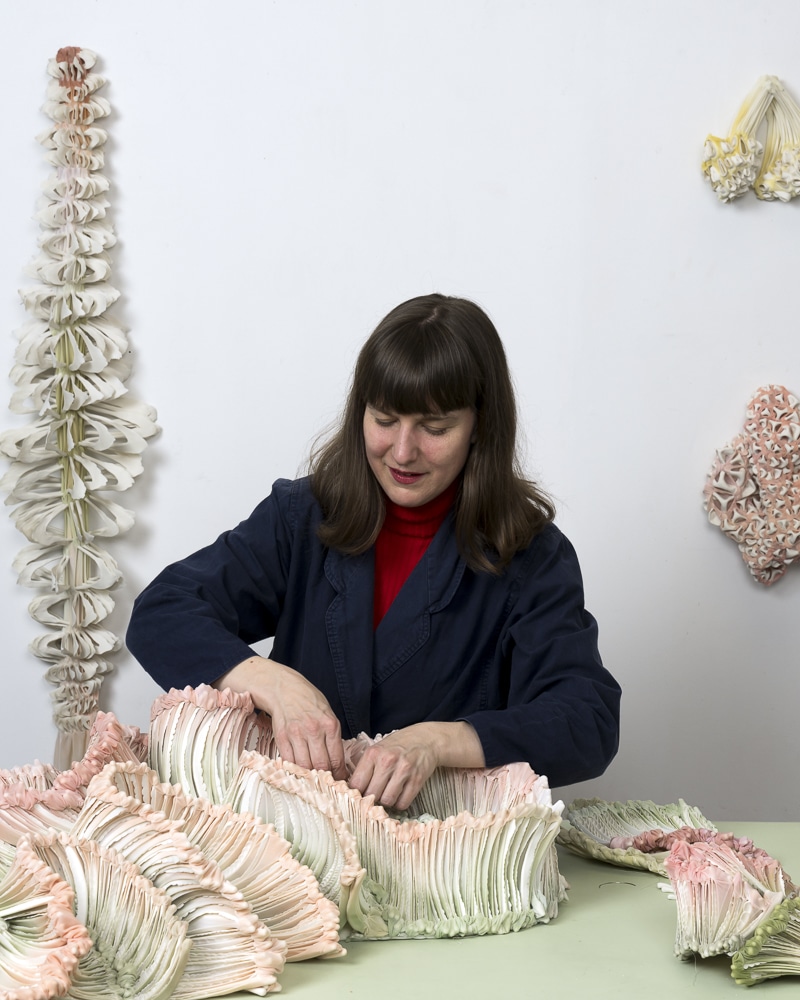
This piece is built from hundreds of modular porcelain elements connected with a hand-dyed nylon fabric. Each element is handmade and unique and carries my fingerprints: the porcelain elements create an inner "bone-like" system, while the textile holds everything together, like a skin. Once the porcelain elements and textile are connected, the textile is dyed in hues of green and pink, while the porcelain remains unaffected by the dye.

For a long time I had worked with colours linked to the body, such as pinks and fleshy tones. For Gewächs VI, shades of green and yellow have entered my practice, expanding the associative field of the work towards more botanical references.

A key influence on this method was a workshop with the Japanese textile designer and artist Hiroyuki Murase, where I was introduced to Shibori, a traditional Japanese resist-dyeing technique. I became increasingly interested in the sculptural potential of the act of tying itself — how tension, compression, and repetition could generate form.
From conception to completion, this piece required 3 months of intensive work. The duration becomes part of the sculpture itself, giving time a physical presence.

“I aim to create the sensation of Visual Tactility, where the viewers can almost feel the texture and physicality of the works through their eyes. By utilizing their knowledge of materials, they can imagine how the artworks would feel if they were able to touch them.”
Discover the signature piece
Photo Credit © Thor Brødreskift
magnifiercross